Best Hand Planes for Woodworking
Hand planes reward patience more than any other hand tool. A well-tuned No. 4 smoothing plane leaves a surface that no sandpaper can match, and a jack plane makes edge-jointing and dimensioning timber genuinely fast. The community splits on brand: Stanley Sweetheart and WoodRiver are accessible entry points, Veritas is the best-engineered production plane you can buy, and Lie-Nielsen is the gold standard that many woodworkers save up for. All of them work. What matters more than brand is setup - a sharp iron, a tight chip breaker, and a flat sole - and these guides walk you through both buying decisions and setup.
BenchTrue may earn a commission from links below . Updated September 2026
What is the best Hand Planes for Woodworking?
The Veritas Custom Bench Plane No. 4 is the best bench hand plane for most woodworkers, built to a higher standard than Stanley or WoodRiver with a thick 0.156-inch iron, a Norris-style adjuster, and a sole flat enough out of the box to need minimal lapping. Value-focused buyers get genuine performance from the Stanley Sweetheart No. 4 at a fraction of the Lie-Nielsen price.

Veritas Custom Bench Plane No. 4 (Smoothing Plane)
The most highly engineered production smoothing plane available. Veritas Custom planes use a 0.156-inch-thick PM-V11 iron, a Norris-style adjuster for precise depth and lateral control, and a ductile iron body machined to tight tolerances. The PM-V11 steel holds an edge longer than A2 with similar sharpening ease. The community considers Veritas and Lie-Nielsen peer tools at slightly different price points.
- PM-V11 steel in the thick iron holds an edge longer than A2 with similar ease of sharpening
- Norris-style adjuster gives precise control with no backlash
- Ductile iron body machined to tight tolerances - minimal sole lapping needed
- Premium price - a significant purchase that rewards woodworkers who have already learned hand planes
Lie-Nielsen No. 4 Smoothing Plane (A2 Steel)
The American-made benchmark smoothing plane, ground from ductile iron with an A2 steel iron ground to a precise 25-degree primary bevel. Lie-Nielsen planes arrive ready to tune and have been the gold standard for production hand planes in the American hand-tool community for decades. The feel and finish are exceptional.
- A2 iron holds an edge through demanding hardwood work
- Exceptional fit and finish - a pleasure to use and to look at in the shop
- American-made with a track record of customer service and part availability
- Price premium over Veritas for planes that are engineering peers in practice
Veritas Low-Angle Block Plane
A 12-degree bed angle with an adjustable mouth makes this block plane the most configurable small plane available at any price. The Veritas block plane shines on end-grain, small chamfers, and tight fitting work where a bench plane is too large. The PM-V11 iron option (sold separately) upgrades it further.
- Adjustable mouth opens and closes for both heavy shavings and fine finish cuts
- 12-degree bed suits end-grain and low-angle applications
- Excellent fit and finish with precision machining throughout
- Overkill for rough work - a cheaper block plane works fine for chamfers and rough trimming
Hock Tools O1 Replacement Plane Iron
Hock Tools make the go-to replacement iron for vintage Stanley planes. The O1 tool steel is thicker than original Stanley blades (0.125 inches), harder, and takes a finer edge. Fitting a Hock iron to a vintage No. 4 is the most cost-effective way to get near-Lie-Nielsen performance from a $30 flea-market plane.
- O1 steel takes a finer, longer-lasting edge than the original thin Stanley iron
- Thicker cross-section reduces chatter on hard and figured wood
- Transforms a vintage Stanley into a genuinely high-performing plane at low total cost
- Requires fitting: chip breaker may need adjustment to seat properly on the thicker iron
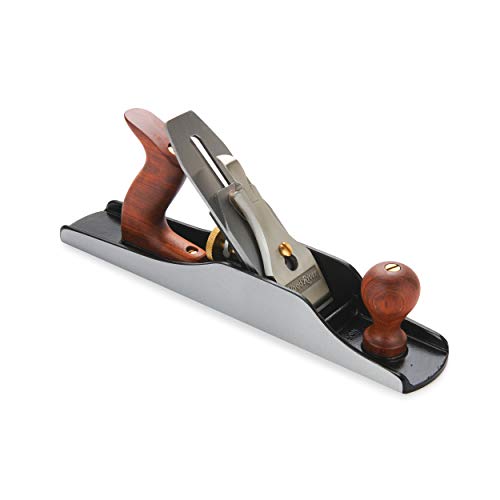
WoodRiver No. 5 Jack Plane
Woodcraft's house-brand jack plane, made to a specification that significantly exceeds the standard Stanley line. The No. 5 jack plane is the workhorse of the hand-tool shop: it dimensions rough stock, flattens wide panels, and does the heavy stock-removal work before the smoothing plane takes over. WoodRiver planes are well regarded for their price-to-performance ratio.
- A2 steel iron holds a good edge for heavy stock removal
- Heavier casting than Stanley with better tolerances than entry-level planes
- Jack plane size makes it the most versatile bench plane for a single-plane shop
- Sole requires lapping on most examples - budget 30 minutes for initial setup
Stanley No. 71 Router Plane (Vintage / Reissue)
A router plane is the hand-tool answer to a plunge router for stopped dadoes, inlay recesses, and hinge mortises. The No. 71 rides the work surface on two wide feet and the iron cuts the bottom of a recess to a consistent depth. Vintage Stanleys are abundant and cheap at flea markets; the Veritas version is the modern reissue with better adjustability.
- Essential for cleaning out dado and housing joint floors to a consistent depth
- Vintage Stanleys work well after tuning and cost very little
- No power tool can match the control of a router plane in stopped work
- Vintage examples need blade sharpening and sole cleanup before use

Stanley Sweetheart No. 4 Smoothing Plane
Stanley's modern premium No. 4, made in England with a 0.100-inch thick iron and a body that is cast and finished to a higher standard than the standard Stanley line. The Sweetheart is not at Veritas or Lie-Nielsen level but it is a genuine working plane that many beginners use well for years before deciding they need more.
- Most affordable route to a purpose-built modern hand plane with Stanley heritage
- English manufacturing with better tolerances than the standard Stanley line
- 0.100-inch iron thicker than economy planes, reduces chatter
- Iron thinner than Veritas or Lie-Nielsen, more prone to chatter in hard wood
The method
How we chose
We evaluated each option on fit, build quality, daily usability, and value. Our top pick, Veritas Custom Bench Plane No. 4 (Smoothing Plane), earned the spot. The best-engineered production smoothing plane available. A lifetime tool. The comparison above highlights exactly who each pick is best for.
Related guides
Head-to-head comparisons
FAQ
Best Hand Planes for Woodworking: FAQ
What is a bench hand plane?+
A bench plane is the general term for the family of full-size hand planes used at the workbench for flattening, smoothing, and jointing wood, as opposed to specialty planes like block or shoulder planes. The No. 4 smoothing plane, No. 5 jack plane, and No. 7 jointer are the three most common bench plane sizes, and the Veritas Custom Bench Plane No. 4 covers the single most useful size for most woodworkers.
What is the first hand plane a beginner should buy?+
A No. 4 smoothing plane. It is the most versatile size, good for flattening, smoothing, and edge trimming, and most woodworking projects need exactly what a No. 4 does. A block plane is a close second for small chamfers and end-grain work. Avoid buying a No. 5 jack plane first - it is useful but less versatile than a No. 4 for learning the tool.
Lie-Nielsen versus Veritas: is the price difference worth it?+
Both are excellent tools, and this is one of the most debated questions in the hand-tool community. Lie-Nielsen (American made, A2 steel, cast iron bodies) and Veritas (Canadian, PM-V11 steel, cast iron bodies) are peer competitors. Veritas has the engineering edge with its PM-V11 steel and Norris-style adjuster. Lie-Nielsen has the aesthetic and heritage edge. Neither is meaningfully better to use - buy whichever you can afford or whichever feel you prefer.
Does a vintage Stanley hand plane need much work to get usable?+
Usually some, but not always a lot. A pre-WWII Stanley in decent condition needs a new iron honed to a keen edge, a chip breaker flattened on the back so it seals against the iron, and the sole lapped flat on a sheet of sandpaper on plate glass. That is two to three hours of setup work for a tool that costs $20 to $60 at a flea market. The work teaches you the plane as you go.
What is a block plane used for, and do I need one?+
Block planes are small, low-angle planes designed for end grain and one-handed use. They chamfer edges quickly, clean up end grain, trim dovetail pins flush, and fit into tight spots where a bench plane does not. Yes, you will use one constantly. A good block plane is the second or third tool most hand-tool woodworkers buy, right after or alongside a No. 4.
What does 'lapping the sole' mean and do I have to do it?+
Lapping means flattening the bottom of the plane on abrasive so it contacts the wood evenly from toe to heel. Premium planes like Lie-Nielsen and Veritas are already flat to a high tolerance and need little to no lapping. Budget planes often have high spots that prevent them from planing true. Check with a reliable straightedge before assuming you need to lap - a premium plane out of the box is often ready to use.